
What Tennessee Households Pay Per Vehicle
Tennessee households pay an average of $936.15 per year per insured vehicle, according to 2023 NAIC data. That figure is the statewide average expenditure across all coverage levels, driver profiles, and household structures. Your household's actual total depends on how many vehicles you're insuring, whether they sit on one policy or separate policies, and whether you qualify for the multi-car discount that most carriers offer when you insure two or more vehicles on the same policy.
The $936.15 average is a per-vehicle figure, not a household total. A household insuring three vehicles does not simply triple that number — the multi-car discount reduces the combined premium when all vehicles share one policy, but adding a vehicle mid-term re-rates the entire policy based on the new vehicle's attributes and the drivers assigned to it. Understanding how Tennessee's average translates to your household's structure is the first step toward an accurate comparison.
Compare car insurance rates in your state
Get quotes from licensed carriers — no obligation, no spam, results in minutes.
Get Your Free QuoteTennessee Per-Vehicle Expenditure
$936.15/year
This is the average annual auto insurance expenditure per insured vehicle in Tennessee as of 2023, drawn from NAIC data. The figure reflects all coverage levels and driver profiles statewide, not a quote for your household.
NAIC Auto Insurance Database Report 2023
How the Multi-Car Discount Changes Your Total
The multi-car discount applies when you insure two or more vehicles on the same policy. Most Tennessee carriers reduce the premium for each vehicle when you combine them, but the discount is not a flat percentage applied uniformly — it varies by carrier, and the savings depend on the base premium each vehicle would carry on its own.
A smaller discount on a lower base rate can produce a better combined total than a larger discount on a higher base rate. That structural reality means comparing carriers on total household premium, not on the advertised discount alone. The multi-car discount typically requires every vehicle to sit on the same policy and often that they share a garaging address. A vehicle titled to someone outside the household or garaged at a different address may not qualify.
Adding a vehicle to an existing policy re-rates the entire policy. The new vehicle's year, make, model, and assigned driver change the risk profile, and the carrier recalculates the premium for all vehicles on the policy. The result is not the old premium plus a flat amount for the new car — it is a new combined premium that reflects the household's updated structure.
The multi-car discount applies to the policy, not per vehicle. Adding a third car re-rates every vehicle on the policy, not just the new one.
What Drives Premium Differences Across Tennessee Households
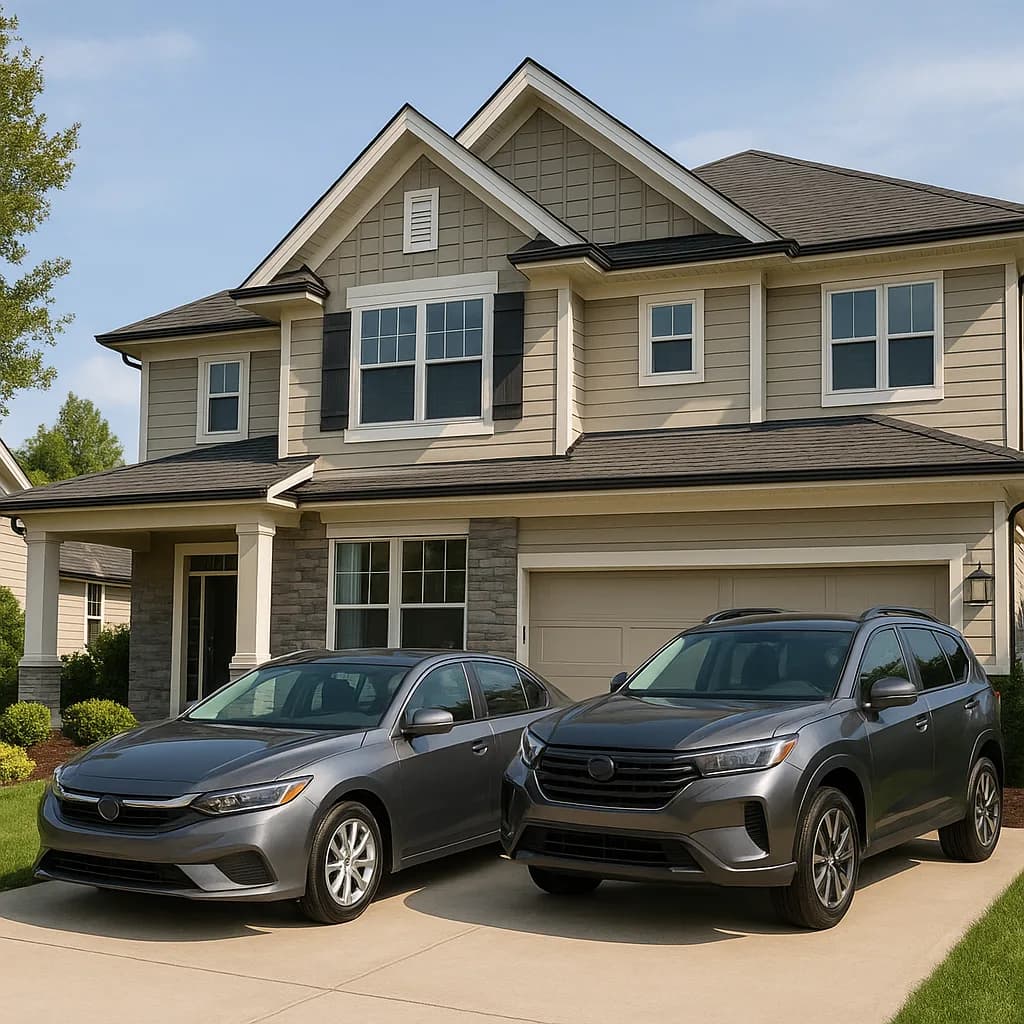
Coverage level is the largest single driver. Tennessee requires $25,000 per person and $50,000 per accident in bodily injury liability, plus $25,000 in property damage liability. A household carrying only those state minimums pays substantially less than one carrying full coverage with collision, comprehensive, and higher liability limits. Households insuring multiple vehicles often carry minimum coverage on older cars and full coverage on newer ones, creating a blended total that reflects both strategies.
Driver profile and vehicle attributes follow. A household with a teen driver assigned to one of the vehicles pays more than a household with two middle-aged drivers, even if the vehicles are identical. Vehicle year, make, model, and annual mileage all factor into the premium. Tennessee's 21.3% uninsured motorist rate and 1.59 traffic fatalities per 100 million vehicle miles traveled shape carrier pricing statewide, but county-level theft rates and claim frequency create variation within the state. A household in a county with higher theft rates pays more for comprehensive coverage than one in a lower-theft county.
Related Articles




How Tennessee Carriers Structure Multi-Vehicle Policies
Tennessee carriers writing multi-vehicle policies include State Farm, GEICO, Progressive, Allstate, Liberty Mutual, Nationwide, Farmers, Travelers, and others. Each structures the multi-car discount differently. Some apply a percentage reduction to each vehicle's base premium; others reduce the total policy premium after combining all vehicles. The discount amount varies by carrier, and the structure affects how much you save when adding a second or third vehicle.
Carriers that write non-standard and high-risk auto insurance — including Direct Auto, The General, Dairyland, Bristol West, and Acceptance Insurance — also offer multi-vehicle policies, often with different discount structures than standard carriers. A household with one driver carrying a violation history and another with a clean record may find better combined pricing from a non-standard carrier that discounts the clean-record driver more aggressively than a standard carrier would discount the household overall.
Combining two existing policies after marriage or a household move typically lowers the combined premium, but not always. If one policy carries a violation surcharge or a high-risk driver, merging it with a clean policy can raise the clean policy's premium more than the multi-car discount offsets. Comparing the combined total against keeping two separate policies is the only way to know which structure costs less for your household.
Tennessee Uninsured Motorist Rate
21.3%
More than one in five Tennessee drivers operates without insurance. That rate shapes carrier pricing for uninsured and underinsured motorist coverage, which protects your household when an at-fault driver cannot pay a claim.
Insurance Information Institute, 2023
Comparing Carriers for Your Household Structure
Tennessee households insuring multiple vehicles should compare carriers on total household premium, not per-vehicle rates or advertised discount percentages. Request quotes that include all vehicles, all drivers, and the coverage levels you plan to carry. The quote should reflect the multi-car discount automatically when you list two or more vehicles on the same policy.
Verify that every vehicle qualifies for the discount. Most carriers require all vehicles to be garaged at the same address and titled to household members. A vehicle titled to someone outside the household or garaged elsewhere may disqualify the entire policy from the multi-car discount, depending on the carrier's rules. If you're combining policies after marriage or adding a household member's vehicle, confirm with the carrier that the new structure qualifies before finalizing the change.
Compare Tennessee Carriers for Your Household
Tennessee's average per-vehicle expenditure is a statewide benchmark, not a quote. Your household's total depends on your vehicles, your drivers, your coverage selections, and which carrier structures the multi-car discount most favorably for your situation. Comparing carriers on total household premium — not per-vehicle estimates or discount percentages — is the only way to identify the lowest combined cost. Use the comparison tool to request quotes from Tennessee carriers writing multi-vehicle policies and see which structure saves your household the most.