
The Multi-Car Discount Only Works When Every Vehicle Sits on One Policy
You own two cars, your spouse owns one, and you've been quoted rates that seem higher than expected for insuring all three. The confusion often starts here: the multi-car discount that carriers advertise applies only when every vehicle in your household sits on the same auto insurance policy. If one car is on your policy and another is on a separate policy—even if both policies are with the same carrier—you do not receive the multi-car discount on either policy.
Tennessee law does not mandate multi-car discounts, but nearly every carrier writing in the state offers one as a competitive tool. The discount structure varies by carrier, but the eligibility rule is consistent: all vehicles must be listed on a single policy, typically garaged at the same address, and often titled to members of the same household. Understanding this structure is the first step toward lowering your combined premium.
Compare car insurance rates in your state
Get quotes from licensed carriers — no obligation, no spam, results in minutes.
Get Your Free QuoteTennessee Average Annual Auto Expenditure Per Vehicle
$936.15
Tennessee drivers paid an average of $936.15 per insured vehicle in 2023, according to NAIC data. Households insuring multiple vehicles on separate policies pay this rate or higher per car; combining onto one policy with a multi-car discount reduces the per-vehicle cost.
NAIC Auto Insurance Database Report 2023
What the Multi-Car Discount Actually Does to Your Premium
The multi-car discount is not a flat dollar amount subtracted from your bill. It is a percentage reduction applied to each vehicle's base premium after the carrier calculates the individual risk profile for each car and driver. The percentage varies by carrier—some apply a larger discount to the second vehicle, others spread the discount evenly across all cars on the policy.
This means the total savings depend on three factors: the number of vehicles, the base premium for each vehicle before the discount, and the carrier's specific discount structure. A carrier offering a smaller discount percentage but starting with a lower base rate for your household's risk profile can produce a lower combined premium than a carrier advertising a larger discount on a higher base rate.
Tennessee minimum liability limits are $25,000 per person for bodily injury, $50,000 per accident, and $25,000 for property damage. Households carrying only minimum coverage see smaller absolute savings from the multi-car discount than households carrying full coverage, because the discount applies to a smaller base premium. If you are comparing quotes, compare the final combined premium after all discounts, not the discount percentage alone.
A vehicle titled to someone outside your household may not qualify for the same-policy multi-car discount, even if it is garaged at your address and you pay the premium.
How to Structure Your Policy to Maximize the Discount
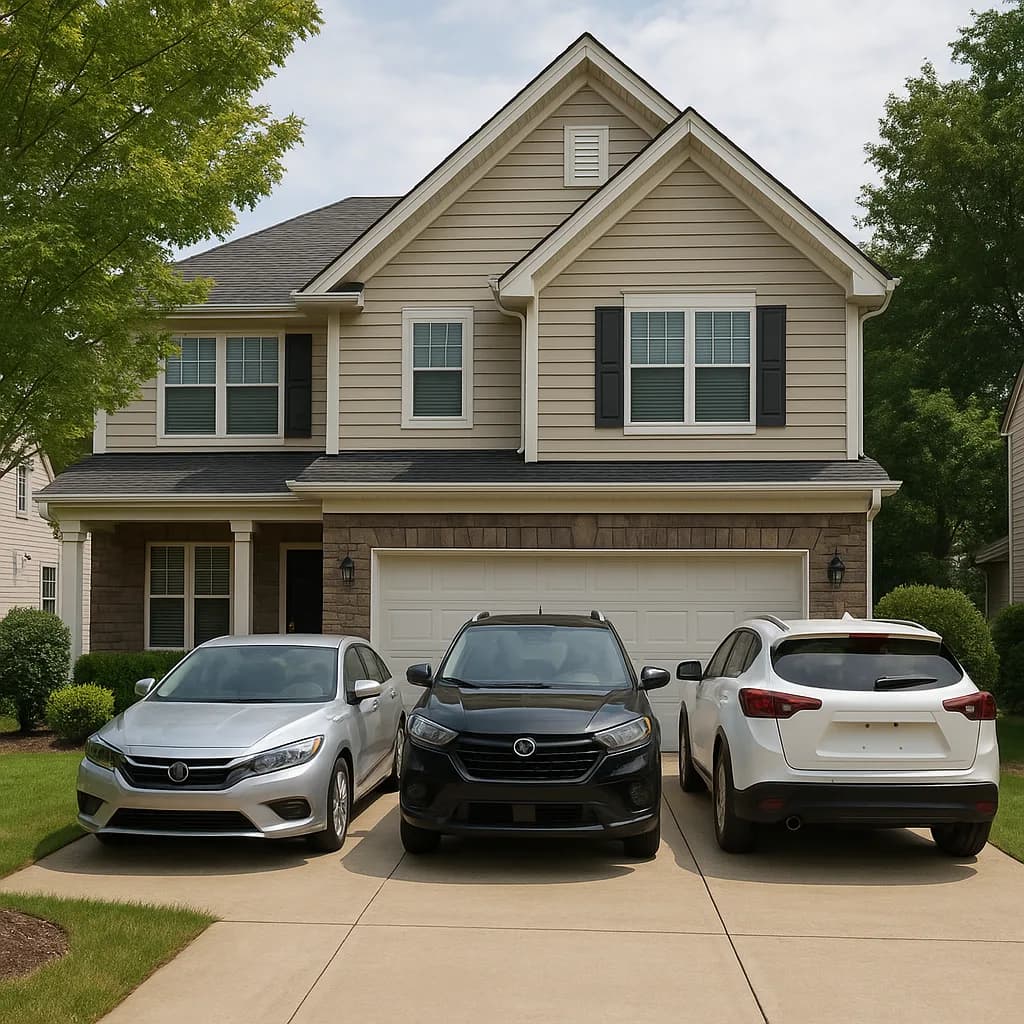
Start by confirming that every vehicle you want to insure is titled to a member of your household. Most carriers define household as people living at the same address who are related by blood, marriage, or legal adoption. Roommates, unmarried partners, and adult children living elsewhere typically do not qualify for the same-policy multi-car discount, though some carriers make exceptions for domestic partners or co-owners. If a vehicle is titled solely to someone outside your household, ask the carrier whether adding that person as a named insured on your policy allows the car to qualify.
Next, verify the garaging address for each vehicle. Carriers require that all vehicles on a multi-car policy be garaged at the same address—the location where the car is parked overnight most of the time. If one vehicle is garaged at a second home, a college campus, or a work location, the carrier may require a separate policy for that car, which eliminates the multi-car discount. Some carriers allow exceptions for students away at school if the student remains a household member and the vehicle returns home during breaks, but this is not universal.
Related Articles




When Adding a Vehicle Mid-Term Costs More Than Waiting for Renewal
Adding a vehicle to an existing policy mid-term triggers a full re-rating of the entire policy, not just an incremental charge for the new car. The carrier recalculates the premium for every vehicle on the policy based on the new household risk profile, which includes the additional vehicle's make, model, year, and the driving record of anyone in the household who might operate it. If the new vehicle is a higher-risk model—sports car, luxury vehicle, or a car with high theft rates—the re-rating can increase the premium for the other vehicles already on the policy.
This re-rating happens immediately when you add the car mid-term, and you pay the prorated difference for the remainder of the policy period. At renewal, the carrier re-rates again based on a full term with all vehicles present. In some cases, waiting until renewal to add the new vehicle produces a lower combined annual premium than adding it mid-term, because the carrier prices the full term as a single risk pool rather than adjusting an existing policy twice.
Tennessee law requires that a newly purchased vehicle be added to your policy within a carrier-specific grace period—typically 14 to 30 days—or the vehicle is not covered. If you are buying a car close to your renewal date, contact your carrier before the purchase to confirm whether adding the car immediately or waiting a few weeks produces a better rate. Some carriers allow you to bind coverage on the new car effective the purchase date but delay the formal policy addition until renewal, preserving the lower rate structure.
Tennessee Uninsured Motorist Rate
21.3%
More than one in five Tennessee drivers operates without insurance. Households with multiple vehicles often add uninsured motorist coverage to protect against collisions with uninsured drivers, which increases the base premium but is eligible for the multi-car discount when all vehicles carry the same coverage.
Insurance Information Institute, 2023
Combining Two Policies After Marriage or a Move
When two people with separate auto insurance policies move in together or marry, combining both policies onto one multi-car policy usually lowers the total household premium, but not always. The combined premium depends on the driving records, vehicle types, and coverage levels each person brings to the new policy. If one person has a clean record and the other has recent violations or claims, the carrier prices the combined policy based on the higher-risk profile, which can increase the premium for the lower-risk person's vehicles.
Before canceling either policy, request quotes from at least three carriers for a combined multi-car policy covering all vehicles. Compare the combined premium to the sum of your current separate premiums. If the combined premium is higher, ask the carrier whether excluding the higher-risk driver from operating the lower-risk person's vehicles—through a named driver exclusion—lowers the rate. Not all carriers allow exclusions, and Tennessee law does not require them, but where permitted they can preserve the multi-car discount while isolating the higher-risk driver's impact to their own vehicle.
Timing matters here as well. If both policies renew at different times of the year, coordinate the combination so that you cancel the first policy at its renewal date and add those vehicles to the second policy at its renewal. Canceling mid-term often triggers a short-rate cancellation penalty, and the carrier may not refund the full unused premium. Combining at renewal avoids the penalty and allows both carriers to compete for the combined policy without mid-term adjustment fees.
Which Tennessee Carriers Write the Largest Multi-Car Discounts
Carriers writing auto insurance in Tennessee include State Farm, GEICO, Progressive, Allstate, Nationwide, Farmers, USAA, Liberty Mutual, Travelers, and others. Multi-car discount structures vary by carrier, and no single carrier consistently offers the lowest combined premium for every household. State Farm and USAA are often competitive for households with clean driving records and multiple vehicles. Progressive and GEICO frequently quote lower rates for households with mixed driving records or higher-risk vehicles. Allstate and Nationwide offer multi-car discounts but may price higher for households in urban counties with elevated theft or accident rates.
Request quotes from at least three carriers, providing identical coverage levels and vehicle details for each quote. Compare the final combined premium after all discounts, not the advertised discount percentage. A carrier advertising a 25 percent multi-car discount may still produce a higher combined premium than a carrier offering 15 percent, if the first carrier's base rates are higher for your household's risk profile. Tennessee does not regulate discount percentages, so carriers set their own structures based on actuarial data and competitive positioning.
Compare Multi-Car Quotes with Identical Coverage to See Your Actual Savings
The only way to know which carrier and policy structure produces the lowest combined premium for your household is to request quotes with identical coverage levels from multiple carriers. Provide each carrier with the same vehicle details, driver information, coverage limits, and deductibles. Ask each carrier to confirm that all vehicles qualify for the multi-car discount under their specific household and garaging rules. Compare the final annual premium for the combined policy, not the per-vehicle breakdown or the discount percentage. Use Tennessee Car Insurance Requirements' comparison tool to request quotes from carriers writing in Tennessee, or contact carriers directly to confirm multi-car eligibility before binding coverage.